
Can You Renovate a Heritage Home Without Losing Its Character?
Some homes have something you can’t quite name. A stone wall that’s been standing since before your great-grandparents were born. Exposed beams that were hand-hewn. Windows that let in light in a way that feels specific to that house and no other.
You didn’t just buy a house. You bought a story.
And now life has changed. The layout doesn’t work anymore. The kitchen frustrates you. You want to stay, you want to love it even more, but you’re not sure how to update it without undoing what made it special.
That’s the renovation we love. Making an older home work for how you actually live now, without losing what it is.
In this blog, we cover:
- What to figure out before you start a heritage or character home renovation, and why it changes everything
- Which elements are almost always worth keeping in an older home
- Maison Maitland, an 1820s carriage house in Maitland, Ontario, became two modern apartments without losing its soul
- How this applies to your home in Ottawa, Brockville, or anywhere in Eastern Ontario
How to Set Your Heritage Renovation Up for Success
The best place to start isn’t with what you want to add. It’s with what you never want to lose. That one shift changes how every decision gets made from there.
The better starting point is your list of non-negotiables.
- What stays no matter what?
- Which elements would make the home feel like a different house if they were gone?
- What are you renovating toward: more space, better flow, an income suite, or accessibility for the years ahead?
Those answers shape everything: the design approach, which trades need to be involved, where the budget goes, and what a successful result look like.
What to Understand Before You Begin
Renovating an older or heritage home isn’t just a design decision; it’s a regulatory and technical one as well.
Depending on your property, there may be local heritage guidelines or approvals required before any work begins. Building codes have also evolved significantly over time, and older homes can come with hidden conditions, from outdated structural work to materials like asbestos or lead.
This is where working with an experienced design-build team matters. Understanding what’s behind the walls, what’s allowed, and how to move forward safely is part of setting the project up properly from the start.
What to Keep When Renovating an Older or Character Home
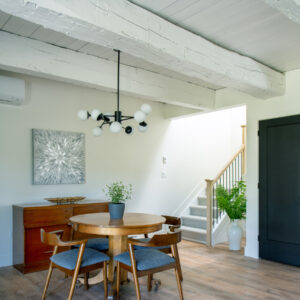
Dave, our Senior Architectural Designer, has a clear view of what makes the difference in a character renovation.
“Once they’re gone, you can’t get them back,” he says. “These are the things that give a home its identity.”
In older and character homes across Eastern Ontario, these are the elements most worth protecting:
- Original stonework or brickwork (interior and exterior)
- Exposed beams and original wood plank ceilings
- High ceilings and original proportions
- Large covered porches and overhangs
- Stained glass, built-in cabinetry, and period hardware
- Rooflines and window proportions that define the home’s silhouette
Of course, what’s worth saving is personal. The point is to make that decision deliberately, not to find out after the walls come down that something was lost you can’t replace.
Heritage Home Renovation in Eastern Ontario: The Maison Maitland Project
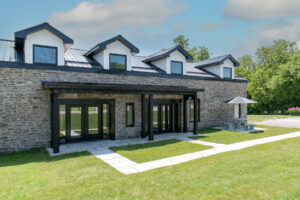
Maison Maitland is a project we revisit often, not just for its looks but for its intentionality.
The clients purchased a property in Maitland, Ontario, anchored by an 1820s stone home and an attached carriage house that was previously used as a wedding venue. Their goal was to convert the carriage house into two income-generating apartments without losing what made the property remarkable.
Their non-negotiables were clear:
- No covering or altering the exterior stone
- New openings only where existing ones already were
- No raising the roofline
- The exposed interior wood beams and plank ceiling were staying.
As a result, the design focused on finding solutions inside the structure rather than around it. For example, the roofline couldn’t be raised, and the team added four dormers to bring in natural light, creating a usable second-storey space. The design introduced covered entrances at the roadside with flat roofs, allowing the stone to remain visible.
“The dormers are all new; they did not exist,” Dave notes. “The roof levels were not changed. We added what was needed within what was there.”
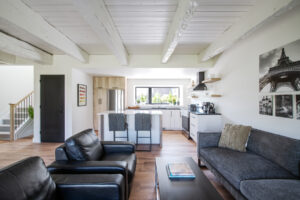
Inside, the team preserved the original beams and painted them white, allowing them to blend into a soft, Parisian-inspired palette without disappearing. The two apartments mirror each other, each with two bedrooms, two bathrooms, a chef’s kitchen, work areas, in-unit laundry, and a private patio.
From Design to Build: The Maison Maitland Construction
On the construction side, heritage renovations come with a different level of complexity.
“There’s always the unknown when deconstructing any property,” says Brad, our project manager. “Even more so in a heritage home. You know the stonework is there, but you don’t know what kind of shape it’s in until it’s exposed.”
On this project, that meant:
- Squaring walls that had shifted over two centuries
- Cutting through 24-inch-thick stone for new openings
- Assembling a structural ridge beam in sections, one piece at a time, because it couldn’t be lifted as a whole
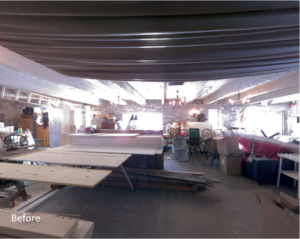
Beyond that, there were the approvals. Converting this type of structure into income-generating apartments is rare in the Maitland and Brockville area. Securing permits required close collaboration with the township and careful planning at every step.
In short, heritage home renovations often involve more unknowns, longer timelines, and additional costs compared to newer homes. The key is having a team that anticipates that and plans accordingly.
Brad sums it up simply:
“Working with everyone involved. Making sure everyone is on the same page about maintaining the character. Understanding the history, and knowing that maintaining it is important.”
Renovating a Character Home in Eastern Ontario
You don’t need an 1820s stone carriage house for this to apply to you.
Whatever your version of “what has to stay,” the process is the same. Start with what matters. Build your design around it. Treat every choice as intentional.
A renovation designed around your priorities is what makes a home feel right. Not just updated. Right.
Ready to Start Your Character Home Renovation?
You don’t need all the answers to get started.
If you’re thinking about renovating a heritage or character home, the first step is understanding what’s possible, what can be preserved, what can change, and what it will take to do both well.
Start with a conversation and book a free consultation. Tell us what you love about your home, what isn’t working, and what you never want to lose.
From there, we can help you build a plan that respects the past while making your home work for the way you live today.
Check out more of our projects here.