
How Accessible Is Your Home? A Room-by-Room Look at What’s Possible
Accessibility is about designing a home that supports you through every stage of life. Whether you’re recovering from an injury, living with a disability, or simply planning ahead so you can stay in your home on your own terms.
An accessible home renovation can mean a lot of things, from a grab bar and some lever hardware to a full bathroom reconfiguration, wider doorways, or a home redesigned for barrier-free living. In this guide, we cover what’s possible in each area of your home.
In this blog, we’ll cover accessibility by area of your home, what can be improved with a small update, and what a renovation makes possible:
1. Entries
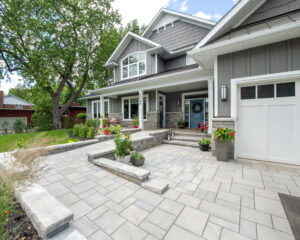
Getting through the front door safely and comfortably is the foundation of an accessible home and one of the areas with the most options at every level of investment.
Small updates:
- Add or reinforce a handrail on exterior stairs.
- Improve pathway and front door lighting.
- Use a portable threshold ramp to address a low step with no construction required.
With a renovation:
- A covered porch overhang keeps the entry clear of ice and rain year-round.
- Level walkways, wider exterior doors, and deliberate exterior lighting.
- A ramped entry can be built to seamlessly blend in with your home.
2. Stairs
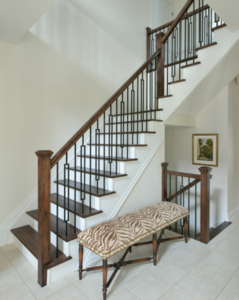
Stairs are one of the most common barriers in a home and also one of the most improvable without necessarily replacing them.
Small updates:
- Add a contrasting nosing strip to the edge of each step so depth reads clearly.
- Improve stair lighting. A motion-activated light at the top and bottom of a flight is one of the highest-impact accessibility changes in a home.
- Check that handrails run the full length and are solidly anchored at both ends.
With a renovation:
- Nosing design, material selection, and integrated lighting can all be addressed structurally for a result that looks intentional and holds up long-term.
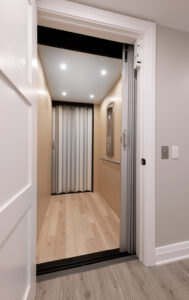
- A home elevator is worth a real conversation. They can be integrated visibly into the architecture or concealed behind what appears to be a standard door.
- An elevator can also be planned during a renovation without being installed right away by incorporating the structural and spatial requirements.
3. Doorways and Hallways
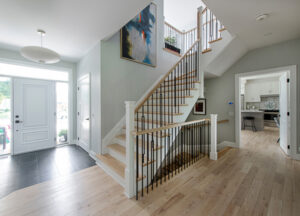
A doorway that’s too narrow affects everything: how you move through the home, how easy it is to carry things between rooms, and how the space will function if needs change.
Small updates:
- Retrofit hinges can add an inch or two of clear opening without touching the frame or wall.
- Replace round doorknobs with lever-style handles throughout.
With a renovation:
- Widening doorways to 34 inches of clear opening or more is most cleanly done when walls are already open.
- Pocket doors are a strong option in tighter spaces where swing clearance is limited.
- Hallway widths can be addressed as part of a larger reconfiguration, improving movement throughout the whole home.
4. Bathrooms
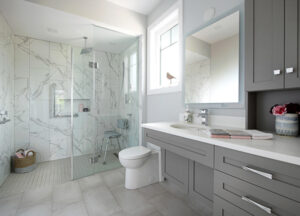
The bathroom is where accessibility barriers show up most often, and where thoughtful design makes the biggest difference. It’s also where the range of options is widest, from a quick hardware swap to a full accessible bathroom renovation.
Small updates:
- Surface-mounted grab bars can be installed without a renovation.
- Swap standard faucets for lever or single-lever options to reduce grip requirements.
- Add non-slip strips to tile or tub floors.
- Comfort-height toilets are a small change with a real day-to-day impact.
With a renovation:
- Adding blocking behind the wall during a renovation means bars can be mounted anywhere as needs change, not just at stud locations.
- Curbless showers mean no threshold to step over and a look that has become a design standard.
- Built-in shower bench improves the experience of the room for anyone using it.
- Open cabinet skirting creates knee clearance for seated use.
6. Kitchen
An accessible kitchen is also a better kitchen, better for cooking, better for hosting, better for everyone who uses it.
Small updates:
- Install pull-out drawer systems in lower cabinets.
- Swap to lever or touch-activated faucets.
- Move frequently used items within easy reach.
With a renovation:
- Lower countertop sections at key prep areas for seated or varied-height use.
- Thoughtful appliance placement and cabinet design that works across ability levels.
- Single-lever or hands-free fixtures integrated into the overall design.
7. Lighting
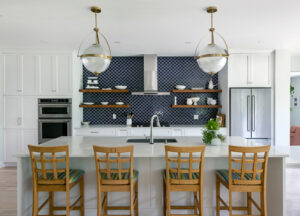
Lighting is one of the most underestimated accessibility features in a home. It affects navigation, confidence, and safety, and improvements can be made at any level of investment.
Small updates:
- Motion-activated lighting in hallways and at the top and bottom of stairs.
- Night lights along routes between the bedroom and bathroom.
- Brighter, shadow-free task lighting at kitchen countertops.
- Dimmable switches so a room can shift from functional to calm.
With a renovation:
- Layered lighting, general, task, and accent, designed as part of the architecture rather than added after the fact.
- Integrated lighting in stair nosings, under cabinets, and inside millwork.
How Accessible Is Your Home?
Not sure where your home stands? We built a short quiz to help you identify what’s working, what could be better, and where a renovation might make the biggest difference.
Ready to start the conversation about what is possible for your home? Book a consultation.